

It’s Whisky of the Week time and our sights are firmly on Maker’s Mark and the second release of Star Hill Farm Whisky.
Yes, Star Hill Farm 2026 Release is here and it doubles down on what made last year’s debut interesting in the first place: wheat, and lots of it, by golly.
Not a bourbon
Let’s get one thing straight first. This. Isn’t. Bourbon. Rob Samuels, eighth-generation whisky maker and managing director of Maker’s Mark, conceived of the idea in 2016. At the time, the rye revolution was just getting started. But why would this brand go that way? Wheat is the story.
If you know your Maker’s Mark, you know its signature grain in the mash bill is soft red winter wheat. But Maker’s Mark is still a bourbon and that means at least 51% corn by law. For its signature bourbon, the recipe consists of 70% corn, 16% soft red winter wheat, and 14% malted barley.
But Star Hill Farm Whisky doesn’t have a corn-led mash bill. The 2026 edition expands the grain mix with hard red and hard white wheat, grown in the autumns of 2017 and 2018 and layered into two mash bills:
- 100% malted wheat
- 70% wheat and 30% malted barley
Blended together, you get a final composition of 27% wheat, 62% malted wheat, and 11% malted barley. Bottled at a chunky 58.2% ABV, this is wheat turned up to eleven. Especially given that most wheated whiskies have some corn in the mash bill. The requirement is simply 51% wheat or more.
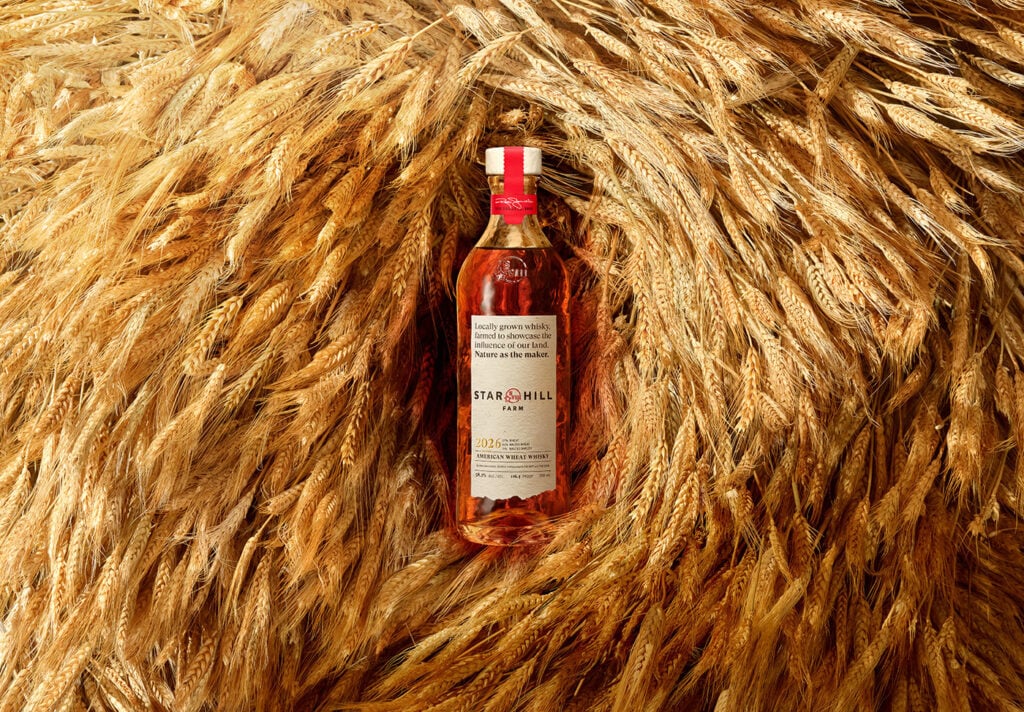
The new Star Hill Farm 2026
You are what you wheat
This is the distillery’s first new mash bill in 70 years. Seventy.
It’s a very interesting step for those of us who like our Maker’s Mark, because one of the things that has set the brand apart is a reputation for consistency. When Maker’s Mark 46 was introduced in 2010, it was the first major addition to the range since 1953. Star Hill Farm represents a step into something more exploratory. And stretching beyond your core without abandoning it ain’t easy. But there’s a couple of things that keep the brand on the side of the angels.
One, wheat is such a part of the Maker’s Mark identity that playing with it further makes sense. In fact, Star Hill Farm is the name of the place where the distillery is located. But the distillery is only part of what’s there. There are orchards, lamb pastures, wagyu pastures, lakes, forests, a white oak repository, a tollgate, a mushroom garden, a cellar, restaurant, wheat fields, an innovation garden, and more besides. All on site. If you visit, by the way, then up to 70% of what you eat and drink can come from the estate. Star Hill is Maker’s Mark understood through a wider lens.
Two, the distillery has been stepping up its work around regenerative agriculture and estate-grown production for a while now, so this is another natural extension. Whisky is an agricultural product. Nature distilled, as Dr Blake Layfield, master distiller, puts it. Water matters enormously here. Kentucky sits on a limestone shelf that filters out iron, which can make whiskey taste harsh, while adding calcium and magnesium that help encourage fruity esters during fermentation.
Then there’s the climate. Mercurial seasons force the spirit in and out of the oak with real intensity. The barrels aren’t palletised and are regularly rotated through the warehouse, helping shape a more consistent maturation despite the wild temperature swings. Add a minimum of seven years ageing and you’ve got the foundations of Maker’s Mark. Dr Layfield is keen to stress, however, that older isn’t always better in bourbon. In Kentucky’s climate, it’s easy to overdo the oak, pulling too much tannin and drowning the spirit beneath the wood. Star Hill Farm keeps the grain front and centre.
Speaking of which, all the grain comes from the estate or controlled land, and Maker’s Mark is the first distillery to be recognised by Regenified for its regenerative farming work. Both the inaugural release and the new edition have an Estate Whiskey certification from the Estate Whiskey Alliance. The cork closure and thick, textured label are made from recycled wheat fibres and label paper waste. You might also notice that the label changes the literal maker’s mark, which replaces the typical “4” Roman numeral with “8” as a nod to Rob Samuels. The “S” and the star remain, as they reference the brand’s home of Star Hill Farm. Did you ever notice that detail before? It was there all along.
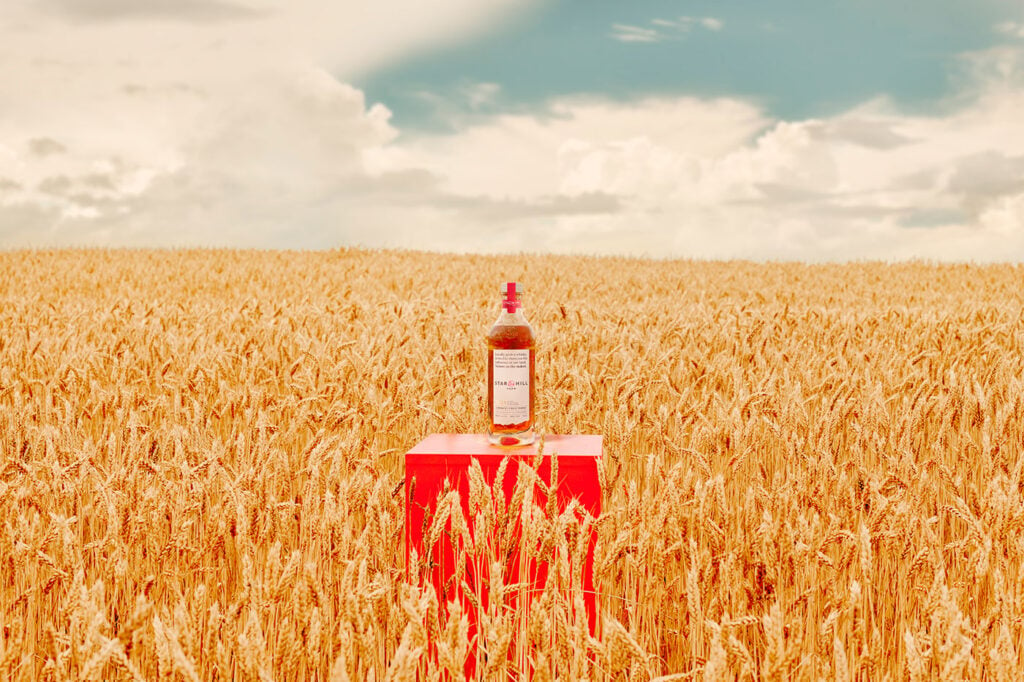
Get Star Hill Farm Whisky 2026 now!
A mission statement
Three, most importantly, Star Hill Farm whisky numero uno was absolutely fucking delicious. That buys you a lot of leeway. Just to underline that point, it won World’s Best Wheat Whisky at World Whiskies Awards 2026, plus Gold at the 2025 International Spirits Challenge, 2025 International Wine and Spirits Competition, 2025 London Spirits Competition, and Double Gold at 2025 San Francisco World Spirits Competition. Impressive.
So how about Star Hill Farm 2026 Release? I got to taste it alongside the ’25 edition first to give the new whisky some context. It turns the cherry of Maker’s Mark darker, like brandied cherries, with chocolate, flinty minerality, butterscotch, charred orange peel, and gingerbread. The texture is thick and glossy. People say wheat is creamy, but this isn’t dairy. It feels more like the way a good sauce glides across your tongue.
The ’26 edition takes things into darker territory with cinnamon pastries, cola laces, apple, black cherry, blackcurrant, fig, marmalade, toasted brown sugar, and Worcestershire sauce. It’s more savoury, almost meaty at points (Parma ham), with more wintery spice and a weighty texture that’s got a hint of molasses about it. Dr Layfield says ’25 is a drinker, ’26 is a thinker. That’s a good way to put it. I like them both a lot. These whiskies are deep. Like a well. The kind you lower yourself into inch by inch, just to see what else is down there.
Corn is the cornerstone of American whiskey. But beyond that, we think of complexity coming from rye. The spice, the chew, the weight. Star Hill Farm is a fine demonstration of the complexity that wheat can deliver. There’s no outsourcing, no guesswork, no compromise. It’s all about growth. From soil to spirit.
UPDATE: We were fortunate enough to attend a tasting today with Dr Blake Layfield, master distiller at Maker’s Mark, and have updated the content with input from his presentation.



